

Introduction:
Gary Goldschneider’s New Theory of Personology posits that astrology, history and psychology are related to the congruence of three cycles: the astrological zodiac, the earth’s rotation around the sun as represented by the seasons of the year and the typical path of a human life.
Gary developed a unique method in his “Birthdays” book that replaces the traditional 12 astrological signs and divides each of the 12 signs into 5 sub-types, such as Aquarius-Pisces Cusp, Pisces I, Pisces II, Pisces III, and Pisces-Aries Cusp, thereby sub-dividing the astrological year into 48 personology week periods that are additionally sub-divided into 366 profiles for each day of the year. The precision this allows is far beyond anything available in any other astrology books. Later, he developed a unique and highly accurate relationship combinations GUIDE of 48 weeks with each 48-week periods. Also, his “Destiny” book contains the most surprising personal Life Paths that we are on and we are heading towards.
A Brief Overview of Personology
Gary Goldschneider’s New Theory of Personology is like astrology in that it recognizes the original twelve heavenly constellations (and the signs derived from them) that form the band called the zodiac, which encircles our earth.
However, Gary Goldschneider’s new BIRTHDAY PERSONALITY-based PERSONOLOGY theory goes further by concentrating on the overlapping area between two signs called the “CUSP”. For example, four of the twelve cusps have immense importance for life as it is lived here on earth, since the spring equinox, the summer solstice, the fall equinox and the winter solstice mark the boundaries of the seasons themselves.
Spring, summer fall and winter succeed one another in an orderly rhythm, for the most part and structure life on the planet along with the unvarying diurnal changes of day and night. In terms of the signs, these cusps are Pisces Aries (spring equinox), Gemini-Cancer (summer solstice), Virgo-Libra (fall equinox) and Sagittarius-Capricorn (winter solstice), in the northern hemisphere. In personology the names of these cusps are The Primal Cusp, The Cusp of Magic, The Cusp of Beauty and The Cusp of Prophecy.
Respectively In personology, those born during these and the other eight cusp periods of six to seven days will share certain characteristics, the descriptions or predictions of which are far broader than those of single sun signs as in astrology. In other words, there is such a thing as a distinct cusp personality. Cusp people are different from others not only because they embody a blend of the sharply contrasting traits of two adjacent signs (such as Aries and Taurus, or Gemini and Cancer) but also because their individuality is not determined by a major sign of the zodiac but frequently by something more indefinable. They are earth-oriented, unpredictable, difficult, unconventional, perhaps. Often those born on cusps find each other extremely attractive, which may or may not bode well for their forming a permanent relationship.
The Basis of Personology
If one considers astrology to be heaven-oriented, personology is earth-oriented. That is, the basic structure upon which personology is built is that of the year as it is lived, and as far as we know has largely been lived here on earth. The rhythms of the year are mostly determined by the changes of the seasons themselves, along with the lengthening and shortening of the days and nights. Each year these solar changes are roughly the same. We are fixed to a wheel of life here on earth, whose motion dictates (in the northern hemisphere) that beginning with the winter solstice, around December 21, the shortest day and longest night, the days will get progressively longer and the nights shorter until the vernal or spring equinox is reached ground March 21, at which point day and night will be equal. We call this season between solstice and equinox winter, expecting that only certain plants will grow, that some animals will sleep or hibernate while others grow a full coat to warm them against the biting winds. As the days grow longer in spring, highly varied forms of life begin to emerge culminating finally in the heat of the summer, beginning on the longest day of the year, the summer solstice, around June 21. With harvest comes the fall and again a period of equal day and night (fall equinox, around September 23). Finally the days grow shorter, the sun no longer rises high in the sky, and the world moves inside to prepare for winter once more.
Thus, for personology, the four most important points of the year are the spring and fall equinoxes, and the summer and winter solstices. These points form a cross around which the wheel of the year revolves. Astrologically, these points do not fall in any of the twelve astrological signs, but rather between pairs of them: the spring equinox falls between the signs Pisces and Aries, the summer solstice between the signs Gemini and Cancer, the fall equinox between the signs Virgo and Libra, and the winter solstice between the signs Sagittarius and Capricorn. Each of these four areas corresponds to an astrological cusp. It may be said, then, that where astrology tends to emphasize the signs, personology tends to depend more on the cusps. Yet there is no real contradiction between the two systems—only a change of emphasis and point of view.
The great psychologist C.G. Jung was fond of reminding us of the natural rhythms of nature and of the fact that certain plants, animals, even shapes and ideas come forth at specific times of the year. Similarly, it was no surprise to him that certain types of people should be born at certain times of the year as well. Jung emphasized that man does not stand outside the natural order. Personology holds that not only are certain types of people born at various times of the year, as Jung or astrology might have predicted, but even specifically on certain days. Jung pointed out that each of us in the human family, regardless of where we were born or how we live, carries with us a huge repository of symbols in a kind of collective or archetypal unconscious. The symbols of astrology itself, on the great mandala of the zodiac, perhaps spring not only from the configurations suggested by the constellations in the heavens, but also from our own shared human archetypes. By looking at the characteristics of many people born on a given day, and correlating what we know about them with basic principles of psychology and astrology, personology seeks to explore certain recurring ideas, actions, concepts and themes which those born on this day—now, in the historical past and in the future—are seemingly fated to encounter.
Personology as a Cyclical Theory
A day is a year is a lifetime is an age. As stated, at the heart of the personology theory is an underlying cyclical orientation. Of the three areas of study most intimately involved in its formation—astrology, history, psychology—only astrology requires one to think cyclically, probably because of the great wheel of the zodiac itself which is based on the spatial metaphor of the three hundred and sixty degrees of the revolving heavens above us. History is often taught as if it proceeds in a straight-line— dates are presented to us like beads on a string that stretches from the indeterminate past to the unfathomable future. Yet Hegel in the nineteenth century presented a different view of history in which cycles and dialectics underlie dynamic, interactive systems (an argument against a straight-line approach).
Astrology teaches, as does the Hindu theory of the great wheel of the ages, that we proceed from one two-thousand-year age to the next, crawling backwards around the zodiac with the precession of the equinoxes, until we reach the beginning once more. W.B. Yeats, the Irish poet and mystic believed that life proceeds in a spiral movement in which two gyres (conceived of as two cones joined at their tips by a common point) symbolize the rise and fall of mankind’s development. His poem The Second Coming begins: “Turning and turning in the widening gyre, the falcon cannot hear the falconer.” The peregrinations of the falcon become a metaphor for the movement of history itself.
In the same way that the medieval alchemists taught “As above—so below,” the followers of George Gurgieff (such as Rodney Collin in his book, The Theory of Celestial Influence), held that the cyclical revolutions of the electron around the atom (in the micro world of 1x10⁷!°) relate to the revolutions of the planets around the sun (in the macro world of 1x10*!), At each step of the way, from the world of trillions to billions to millions to thousands to tens, or vice-versa, from the very small to the very large, revolves another world, and near the middle, the zero point, lies our world of everyday life. Newton’s laws were mainly formulated for this near-zero-point world, but had to be modified as science examined increasingly larger (stellar) or smaller (microscopic) universes.
Personology posits this central analogy: a day is a year is a lifetime is an age. It modifies conventional astrology in two ways—first in the empirical, earth-oriented emphasis described above, and, second, in thinking about each sign as simply a further evolution of the one before it. In this way an astrological sign is really nothing absolute in itself but rather a spoke in the great wheel. Dane Rudhyar was the most important astrologer of our time to propose and clarify this idea.
In order to explain an astrological sign in human, developmental terms, a complete cycle of the zodiac is taken to represent an eighty-four-year human life (suggested by Uranus, whose cycle around the sun takes eighty-four years), and so a “life” can be divided into twelve equal seven-year segments. For example, Aries, the first sign of the zodiac, may be likened to the period from birth to seven years of age. A trip around the zodiac from Aries to Pisces, which is the format of The Secret Language of Birthdays, becomes the cycle of the human life itself, from birth to death. Historically seen, we may be looking at a partial explanation for why similar personalities are born in different time periods under the same sign, cusp or on the same day.
The cyclical unfolding of repetitive “incarnations”—much like Yeats’s gyres—suggests a certain personality type arising at a higher or lower level of the spiral, but always in the same location in any given year.
In the area of psychology, Erik Erikson modified Freud’s more static ideas of developmental stages (oral, anal, phallic) into a more human format which defined a stage dynamically (for example, trust vs. mistrust) in his seminal work Childhood and Society. Yet, until about twenty years ago, most psychologists concentrated principally on childhood as the time of development, neglecting middle and old age. Only the Rosicrucians gave equal emphasis to all the periods of man’s life, from the youngest to the oldest.
The increasingly holistic and humanistic view of psychology is at last beginning to prevail in our time. Abraham Maslow, to whom this book is partially dedicated, believed that every human being must continuously evolve throughout life to ever higher stages, and that getting stuck, refusing or being unable to progress further, is a true living death. Maslow insisted, throughout his life, that every human being must strive to be the very best person he or she is capable of being.
Thus, bringing astrology, history and psychology together in concentric cycles or spirals—stressing evolutionary rather than static models for the individual—is at the heart of personology. The personality types presented under the twelve signs, forty-eight periods and three hundred and sixty-six days (including the leap year extra day) are flexible and fluid, each evolving from one to the next, constantly in motion, constantly changing, rather than fixed in stone.
The Theory of THE GRAND CYCLE OF LIFE
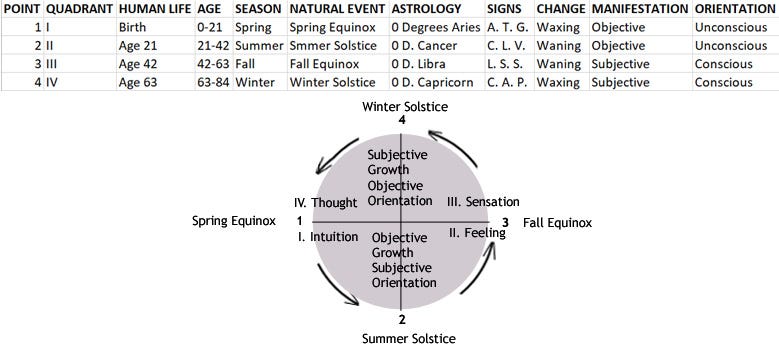
All of life can be conceived symbolically as one grand cycle. By analogy , three important areas can be studied and compared within a circular framework: human life, nature, astrology. For humans, the circle may represent a lifetime, from birth to death; for nature, the inexorable succession of the seasons through a year; in astrology, the zodiac, depicting the signs and their positions. The circle on which these three worlds are based is divided by two axes: one horizontal, one vertical. To travel through a cycle, one need only begin at the left end-point of the horizontal axis and proceed in a counterclockwise direction until one arrives back at the beginning. The four most important points on the circumference of the circle are where the two axes touch it.
UPPER AND LOWER HALVES OF THE CIRCLE
The horizontal axis splits the circle into two halves. The lower half of the circle, or first half of the life cycle, represents objective, outward growth in human and natural terms (birth to age forty-two, spring to fall). During this period, dramatic physical growth takes place that transforms both individuals and the landscape. These objective changes in humans are paralleled by a deeply personal way of viewing the world. Thus, in astrological or psychological terms the lower half may be seen as subjective (more unconscious) and the first six signs, ruled by the “inner” planets (Mercury, Venus, Mars) and two luminaries (Sun, Moon) in our solar system, can be classified as “personal” signs. These five heavenly bodies are almost always viewed in terms of everyday feelings and emotions, familial and romantic relationships with others, and matters of the here and now, rather than more complex philosophical matters or universal concerns. The dominant faculties here are themselves more subjective—intuition and feeling. We may say, then, that the first half of life manifests objectively but is unconscious in its psychological orientation. The upper half of the circle, or second half of the life cycle, represents subjective, inward growth in human and natural terms (age 42-84, fall to spring). During this period, both in nature and the human psyche, a deepening and maturation takes place beneath the surface of life. This “underground” activity is accompanied by an ever-increasing objectivity in the way human beings are able to view events around them, resulting in a wiser outlook and perhaps a more pragmatic view of things. Thus, in astrological and psychological terms the upper half can be viewed as being objective (more conscious): signs 7-9 can be classified as “social” and signs 10-12 “universal.” Except for Libra, these six signs are all ruled by the “outer.” impersonal planets in our solar system (Jupiter. Saturn. Uranus, Neptune. Pluto). These massive and distant bodies carry- more universal and philosophical associations. They symbolize larger social questions: fate, destiny, and the inexorable and eternal aspects of life. The dominant faculties here are more objective ones—sensation and thought. Thus, the second half of life is the reverse of the first, i.e.. it manifests subjectively (inside, beneath the surface) but is more conscious in its psychological orientation.
THE GRAND CYCLE OF LIFE
LEFT AND RIGHT HALVES OF THE CIRCLE
By contrast, the vertical axis divides the circle into a right half and a left half. The left hand side of the zodiac wheel (from Capricorn to Cancer) represents waxing—during the seasons winter and spring the days get progressively longer. The right hand side (from Cancer to Capricorn) represents waning—as we pass through the seasons summer and fall the days get ever shorter. Since the points of summer and winter solstices are at the ends of this vertical axis, they show the maximum polarity: long day-short night (June 21) and short day-long night (December 21). In the / Ching (The Book of Changes) these extremes or poles represent the most yang and yin points of the year, respectively. The equinoxes, on the other hand, mark points of maximum movement either toward (March 21) or away from (September 23) the sun, and demonstrate a perfect day-night balance.
THE QUADRANTS
The two sets of hemispheres just presented (upper-lower, left - right) may be combined simply by superimposing them on each other. In this way, the three hundred and sixty degree circle of life is divided into four quadrants. In the human lifetime of eighty-four years, each of these quadrants represents a period of twenty-one years: in the yearly cycle of nature, a season: in astrology’, a group of three signs (the order of which is invariably cardinal, fixed and mutable). In addition, each of these quadrants may be associated with a mode of apprehending the world:
I Intuition
II Feeling
III Sensation
IV Thought
Each of the four quadrants then, whether representing a season, a twenty-one year period of life or a ninety-degree slice of the zodiac, can be assessed in terms of change, manifestation, orientation and a mode of apprehension. Because The Secret Language of Birthdays is based on a distinctly earth-oriented system, the two equinoxes and solstices occupy a position of central importance in demarcating The Grand Cycle of Life. In this respect, the traditional heavenly-oriented astrological view is given a shift of emphasis to the here and now of our daily life—the eternal cyclical progression of the seasons and life periods, the rhythms of existence which we experience year after year on our home planet.
Bellow are three images summarizing the theory The Grand Cycle of Life
Image 1:
Grand Cycle of Life Overview and Summary Graphic Illustration from the bestselling books (The Secret Language series) by Gary Goldschneider. Includes List of Names for each 48 Weekly and 366 Daily Personality Descriptions. (* Please Note the detailed daily descriptions aka The Birthday descriptions are available only in the book titled “The Secret Language of Birthdays”.
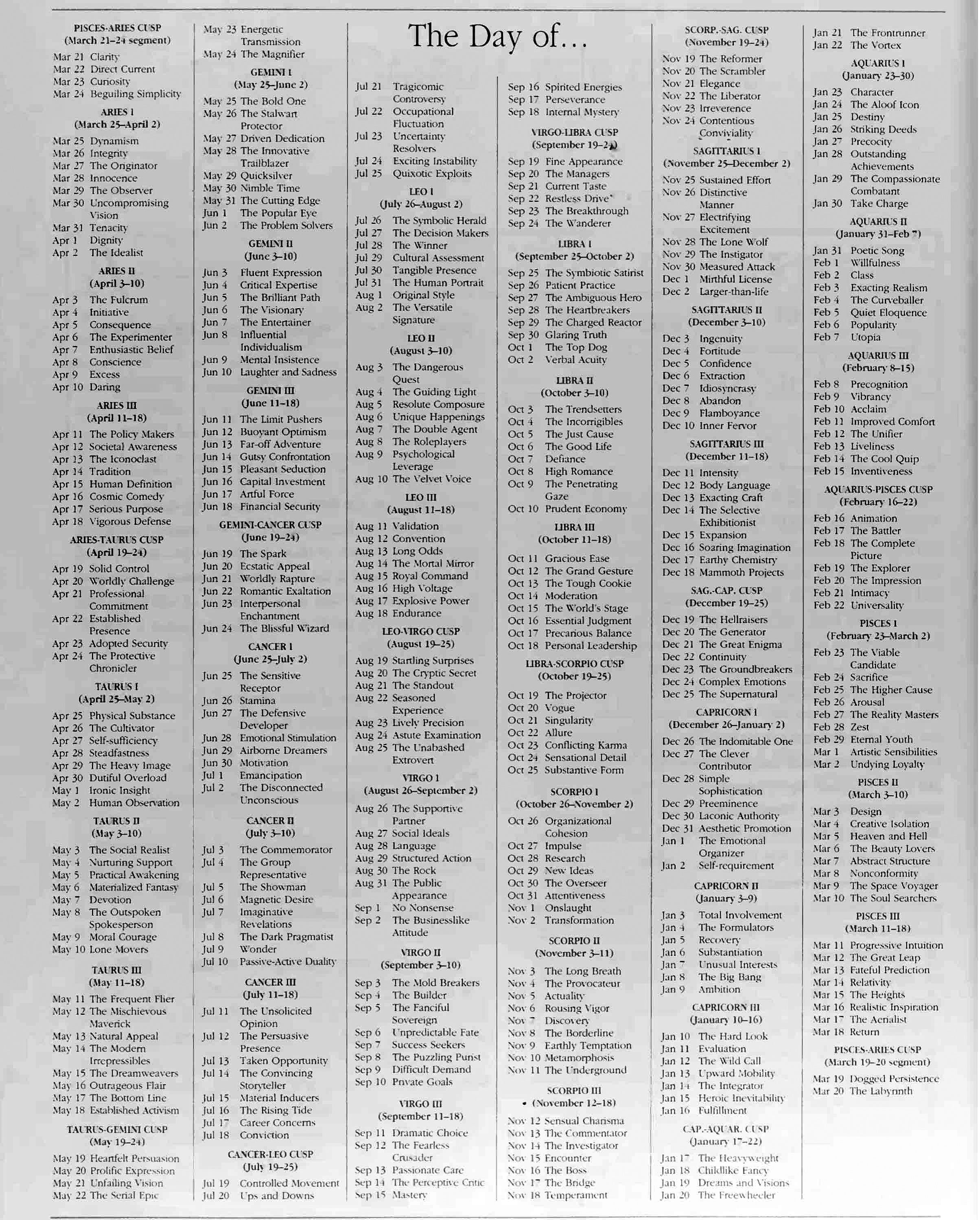
Image 2:
Grand Cycle of Life Overview and Summary Graphic Illustration from the bestselling books (The Secret Language series) by Gary Goldschneider. Includes Names of 48 Weekly Periods within each sign. Light blue sections with the circle are the Names of the Cusp period within each sign. The Roman Numerals in Image 1 with the Names of the Signs and dates of the corresponding week coincide with the Name Titles in Image 2, t.i. Name Descriptions for each 48 Weekly Periods.
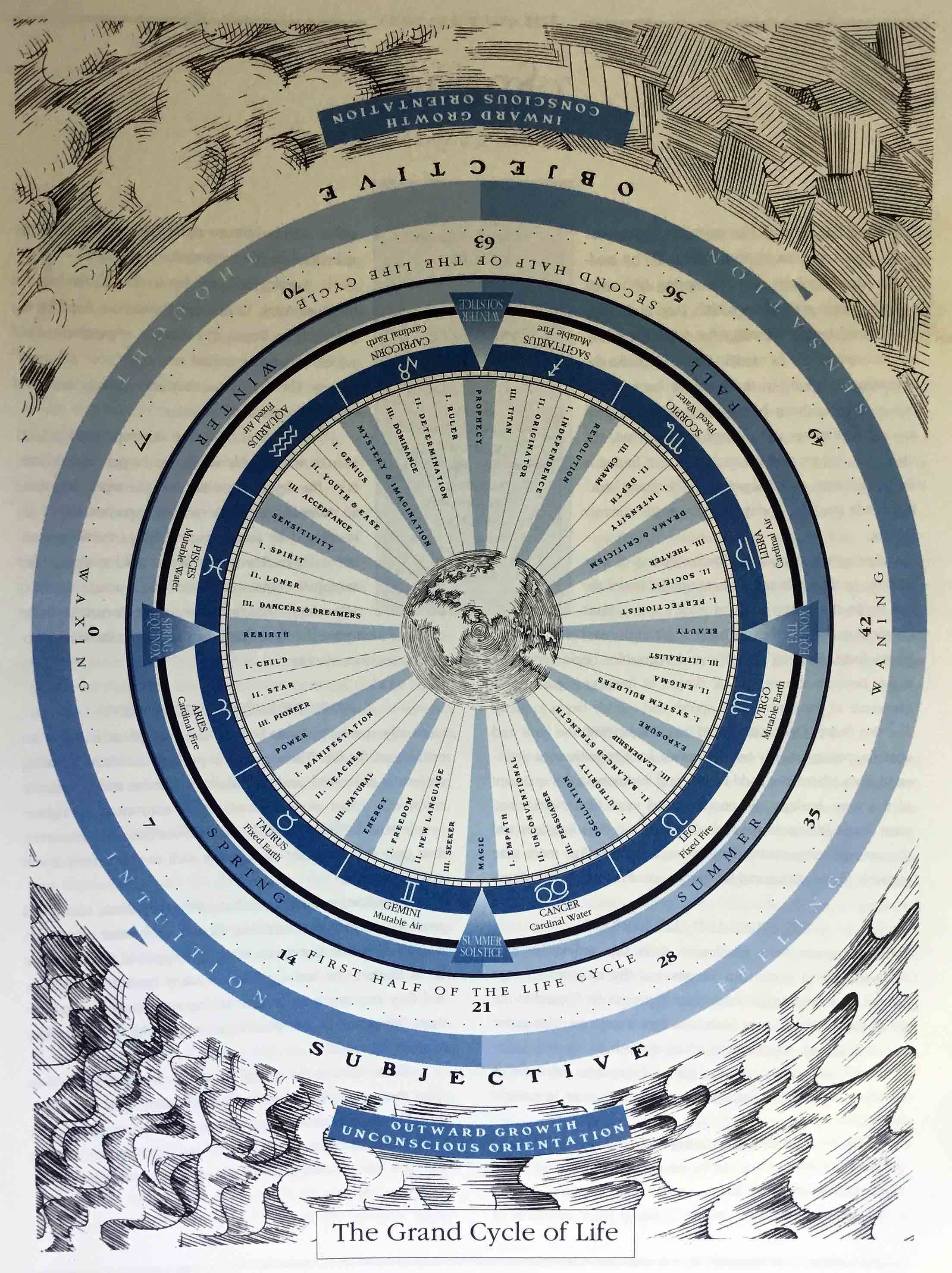
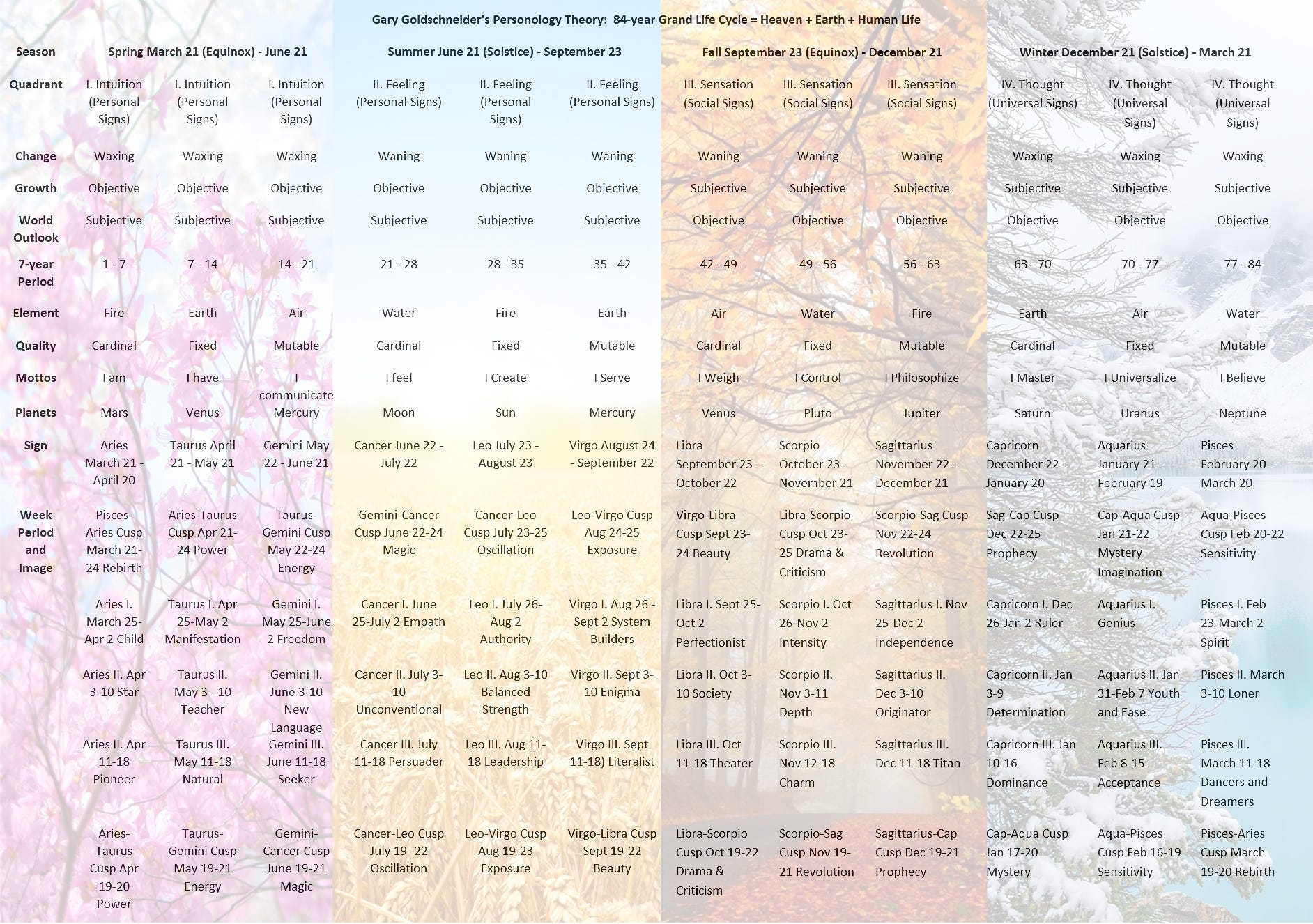
Image 3:
The Summary of the Grand Cycle of Life in Table format includes Names of 48 Weekly Periods with Names of the Signs and their respective dates.
Personology Quarterly,
The Four Seasons of Spring, Summer, Fall and Winter
SPRING (MARCH 21-JUNE 21)
ZODIAC POSITION 0° Aries-0° Cancer QUADRANT First
HUMAN AGE 0-21 CUSP CONCEPTS Rebirth, Power, Energy
SIGNS Aries, Taurus, Gemini
RULERS Mars, Venus, Mercury
SYMBOLS The Ram, The Bull, The Twins
ELEMENTS Fire, Earth, Air
MOTTOS I Am, I Have, I Communicate
DOMINANT FACULTY Intuition
The beginning of the astrological year has been fixed as 0° Aries (March 21) by modern astrology. On this spring or vernal equinox, which symbolizes rebirth, days and nights are of equal length. Astrology has taken the northern hemisphere for its model (March 21 marks the beginning of spring in the northern hemisphere, but in the southern hemisphere spring begins around September 23). As spring wears on, the days grow longer and the nights shorter. Spring is the first quarter, or 90° segment, of the yearly cycle. It extends from the spring equinox to the summer solstice. Springtime is traditionally the period of new growth. As the earth and air heat up, the fire of the sun melts the winter ice and snow. Spring rains coupled with swollen rivers bring water to the earth and new life bursts forth. Planting of crops and vegetables begins once the nights become shorter and all danger of freezing is past. Seeds germinate in the earth, plants sprout and quickly begin to grow. The first flowers blossom, and in combination with the birds and animals, perhaps newly-born, returned from migrations or awakened from hibernation, add beauty and liveliness to this quadrant of the year. Analogously, people spend more time outside and wear fewer but more colorful clothes as the days lengthen and the average temperature rises. More daylight means more time available for recreation and the enjoyment of natural surroundings.
THE SIGNS AND LIFE PERIODS
Spring comprises three astrological signs: the cardinal fire sign Aries, the fixed earth sign Taurus and the mutable air sign Gemini. In human terms, these three signs can be likened to the life of the individual from birth until age twenty-one. This active period of human development, which spans birth, infancy, childhood and adolescence, displays many of the same processes of growth, differentiation and development which occur in nature’s springtime. This first quadrant of The Grand Cycle of Life is governed by the faculty of intuition and can be seen as a waxing period which manifests objectively and has an unconscious orientation. That is to say, although objective growth is taking place externally in nature and in humans during this period, the internal state is highly subjective. Astrologically, this has to do with the fact that the signs Aries, Taurus and Gemini are ruled by the planets Mars, Venus and Mercury, respectively, all of which can be classified as “inner” or “personal” planets. This means that they are relatively small and close to the earth and the sun. The period of human development age 0-21 also shows a highly subjective or personal orientation. The developing child sees the world largely as an extension of him/herself. Its apprehension of life is colored by intuitions and by powerful unconscious drives. The power of the child to absorb and assimilate impressions from the outside world is astonishing. Sometimes the young person is at the mercy of such powerful forces, and does not act in the most rational or conscious manner.
THE SPRINGTIME PERSONALITY
Generally speaking, those born in the springtime manifest an enthusiasm for life. Their energy is prodigious where initiating projects is concerned, and their ability to survive and/or adapt is noteworthy. Often more extroverted than introverted, springtime people tend to impact heavily on their environment. However, their capacity to dutifully or doggedly stick to one activity is not necessarily great. Springtime people like to share what they think, create and produce, and they are, more than those born in other seasons, in need of fairly constant appreciation and approval for what they do. A desire to be free characterizes many born in this season, and they may not react well to having restrictions imposed on them. Springtime people need to grow, expand and make their mark on the world. Those born in the spring often carry a childlike air about them their whole life long. Innocence, spontaneity, impulse these are all characteristic of springtime people. Generally positive in their outlook, they may be put off by highly serious attitudes and have little patience for those with negative orientations.
SUMMER (JUNE 21-SEPTEMBER 23)
ZODIAC POSITION 0° Cancer-0° Libra QUADRANT Second
HUMAN AGE 21-42 CUSP CONCEPTS Magic, Oscillation, Exposure
SIGNS Cancer, Leo, Virgo
RULERS The Moon, The Sun, Mercury
SYMBOLS The Crab, The Lion, The Virgin
ELEMENTS Water, Fire, Earth
MOTTOS I Feel, I Create, I Serve
DOMINANT FACULTY Feeling
The summer solstice usually occurs on June 21 in the northern hemisphere (this date marks the beginning of summer in the northern hemisphere, but in the southern hemisphere summer begins on December 21). At this magical time, days are longer and nights shorter than at any other time of the year. As summer wears on, however, the days shorten and the nights lengthen. Summer is the second quarter, or 90° degree segment, of the yearly cycle. It extends from the summer solstice to the fall equinox. Summer is traditionally the period in which the new life of springtime grows to maturity. Temperatures are at their warmest during this period, and most of animal life experiences lazy afternoons when it is too hot for much movement. Tnis is traditionally the time for vacations, for taking off from work to enjoy all kinds of outdoor activities. School is out, and more young people are thus active and about in the mornings. Colorful flowers and blossoms abound. All the fullness and abundance of nature is revealed. The rhythm of life in this quadrant is slower and more sensual, but diets tend to be lighter, and clothing freer. Life is in many respects easier in summer than at any other time of the year.
THE SIGNS AND LIFE PERIODS
Summer comprises three astrological signs: the cardinal water sign Cancer, the fixed fire sign Leo and the mutable earth sign Virgo. In human terms, these three signs can be likened to the life of the individual aged 21-42. This dynamic period of human development, which spans early adulthood to the mid-life period, displays many of the same processes of growth, flowering and producing which occur in nature’s summertime. This second quadrant of The Grand Cycle of Life is governed by the faculty of feeling and can be seen as a waning period which manifests objectively and has an unconscious orientation. That is to say, although objective growth is taking place externally in nature and in the human being during this period, such growth has already slowed down. Like childhood, the orientation remains primarily subjective. Astrologically speaking, this has to do with the fact that the signs Cancer. Leo and Virgo are ruled by the heavenly bodies The Moon, The Sun and Mercury, all of which are said to be “inner” or “personal” in the solar system. This means that they are relatively close to the earth and take approx. one month (for the Moon) and one year (for the Sun and Mercury) to travel around the zodiac. Like childhood and adolescence, the period of human development age 21-42 is highly personal in outlook, but much objectivity and acquired wisdom has also manifested. The maturing adult is able to discriminate between his/her internal self and the outside world. Not everything is so highly colored by intuitions and powerful unconscious drives as before. Although the capacity to absorb and assimilate impressions is still great, many entryways to the personality and ego have already closed. The maturing adult is also far less at the mercy of the subjective self, and now acts in a more rational and conscious manner than before.
THE SUMMERTIME PERSONALITY
Generally speaking, those born in the summertime have more measured responses than those born in the spring and, although enthusiastic, are more critical. Their energies are perhaps a bit less focused on initiating projects and more on bringing them to fruition. Summertime people tend to be a mixture of introvert and extrovert, but feelings now play a more important role in coloring their lives. Empathic urges to help and become involved with others are strong during this period. Summertime people often experience an emotional interaction not only with people but with their work and environment. Summertime people may not display an overwhelming need to bring their contributions out in the world. Many hidden characteristics develop at this time, and being appreciated is not always the most important thing. Rather than placing their freedom and independence above all else, summertime people are prepared to serve others and also to invest time in them. Summertime people need to be needed.
FALL (SEPTEMBER 23-DECEMBER 21)
ZODIAC POSITION 0° Libra-0c Capricorn QUADRANT Third
HUMAN AGE 42-63
CUSP CONCEPTS Beauty, Drama and Criticism, Revolution
SIGNS Libra, Scorpio, Sagittarius
RULERS Venus, Pluto, Jupiter
SYMBOLS The Scales, The Scorpion, The Archer
ELEMENTS Air, Water, Fire
MOTTOS I Weigh, I Control, I Philosophize
DOMINANT FACULTY Sensation
The fall equinox usually occurs around September 23 in the northern hemisphere (though, of course, in the southern hemisphere fall begins on March 21). At this time of harvest, days and nights are again of equal length. As fall wears on. however, the days grow shorter and the nights longer. Fall is the third quarter, or 90° degree segment, of the yearly cycle. It extends from the fall equinox to the winter solstice. Fall is traditionally the period at which time the final harvest of summer growth takes place afterwards, much of the ground is covered by leaves or mulch for the winter. A decomposition of plant life now begins by which the earth is enriched. Most of the farmland lies fallow during this period but some winter crops can be planted. Temperatures begin to drop as the sun shares less of itself, and freezing nights are evinced by morning frost. Some animal life goes into hibernation or migrates to a warmer climate. Deciduous trees change color in riotous displays, and an autumn nip is in the air. The rhythm of life of this quadrant is quicker and more survival-oriented. High-energy or bulk diets are preferred here (both by animals and humans). The bounty of foodstuffs is waning, and life again becomes more difficult.
THE SIGNS AND LIFE PERIODS
Fall comprises three astrological signs: the cardinal air sign Libra, the fixed water sign Scorpio and the mutable fire sign Sagittarius. These three signs can be likened in human term
s to the years 42-63 in the life of an individual. This powerful period of human development which spans the onset of the midlife period to late middle age. evidences some of the same aspects of maturation, conservation of movement and energy, and added emphasis on survival, as does nature’s autumn. This third quadrant of The Grand Cycle of Life is governed by the faculty of sensation and can be seen as a waning period which manifests subjectively and has a conscious orientation. That is to say, subjective, underground, interior activity has replaced outward growth in both nature and the human being. But psychologically, a conscious and objective awareness of the process of aging is all too clear. Difficulty in accepting such changes, and often a need to control them, are also apparent. Astrologically, this is related to the fact that the signs Libra. Scorpio and Sagittarius are ruled by the heavenly bodies Venus. Pluto and Jupiter, the last two of which are outer, “universal” planets. These outer planets are far from the earth and take approx. 12 years (for Jupiter) and 248 years (for Pluto) to travel around the zodiac. Venus, on the other hand, is a “personal” planet which lends strong social and sensuous influences. Unlike the period from birth to the mid-life, the outlook of the adult at this time is more social than personal. Objectivity, criticism, conscious thought, and awareness characterize this intensely realistic period. A new seriousness and philosophical attitude appears. Intuition, feeling, and thought are all exercised, but sensation becomes a unifying theme, i.e., objective assessment of phenomena as well as a more conscious enjoyment of sensuous pleasures.
THE AUTUMNAL PERSONALITY
Generally speaking, those born in the fall demonstrate both a greater ability and need to control their external environment. Autumnal people are rarely as enthusiastic as those born in the spring and summer, being rather more selective and critical. Maintenance is the overriding consideration here rather than initiation or development of new projects. In some respects, autumnal people tend to be more introverted and thoughtful than springtime and summertime people. Feelings are kept under stricter control. Yet. social urges are more maturely and fully expressed here also—friendships, group and community activities, direct working contributions to society are important at this time. Autumnal people manifest a strong urge to share and take part in serious and fulfilling relationships. Those born in the fall have a heightened awareness of what is going on around them, perhaps greater than that of any other seasonal group. Impulse and emotion may be lower key in autumnal people, but often more subtle and complex. Both self-understanding and self-control are given high priority.
WINTER (DECEMBER 21-MARCH 21)
ZODIAC POSITION 0° Capricorn-O Aries QUADRANT Fourth
HUMAN AGE 63-84
CUSP CONCEPTS Prophecy, Mystery and Imagination, Sensitivity
SIGNS Capricorn, Aquarius, Pisces
RULERS Saturn, Uranus, Neptune
SYMBOLS The Goat, The Water Bearer The Fish
ELEMENTS Earth, Air, Water
MOTTOS I Master, I Universalize, I Believe
DOMINANT FACULTY Thought
The winter solstice usually occurs on December 21 in the northern hemisphere (this date marks the beginning of winter in the northern hemisphere, but in the southern hemisphere winter begins around June 21). At this time of stillness, nights are longer and days shorter than at any other time in the year. As winter advances through the bitter days and on to the hint of spring, the nights grow shorter and the days longer. Winter is the fourth and last quarter, or 90° degree segment, of the yearly cycle. This season extends from the winter solstice to the spring equinox. Winter is traditionally the period at which the water in ponds and rivers freezes, snow falls, the sounds of nature are muted and the land lies sleeping under a white blanket. Trees stretch their bare arms into a gray sky only lit a few hours a day by a low rising sun. Although much of nature seems dead, this is only a surface view. Deep within the earth, powerful forces are engaged in a metamorphosis, the results of which will be evident to the eye in spring. Nothing really dies but is transformed into another state. There is a feeling of waiting. and of expectation. Life has moved inside and underground. Warmth is sought in caves and in houses from bitter, howling winds. Fire keeps humans warm and foods that have been stored for the winter are eaten by both people and animals.
THE SIGNS AND LIFE PERIODS
Winter comprises three astrological signs: the cardinal earth sign Capricorn, the fixed air sign Aquarius and the mutable water sign Pisces. These three signs can be likened in human terms to the life of the individual aged 63-84. This spiritual period of human development from late middle age to death, evidences many of the same aspects of stillness, interiorization of experience and a quieting of instinctual demands that characterize nature’s winter. This fourth quadrant of The Grand Cycle of Life is governed by the faculty of thought and can be seen as a waxing period which manifests subjectively and has a conscious orientation. Although subjective, underground, interior activity has completely replaced outward growth in both nature and the human being, objective changes are on the way. In the case of humans, consciousness may have become less concerned with the externals and more with the worlds of thought, religion, philosophy, spirituality and other universal concerns. Astrologically, this is related to the fact that the signs Capricorn, Aquarius and Pisces are ruled by the heavenly bodies Saturn, Uranus and Neptune, which are all heavy, “outer” planets. These bodies are big and far from the earth, taking approximately 28, 84 and 165 years, respectively, to make their way around the zodiac. The outlook of the adult at this time is more universal. Such concerns as competing in the marketplace, raising a family, reproducing, building a powerful exterior and striving to make a mark in the world of society are generally diminishing or even completely absent now. The elder must prepare psychologically for the coming of the end of a life cycle.
THE WINTERTIME PERSONALITY
Generally speaking, wintertime people are more concerned with the larger picture. They can be dominant types who rule their space with assurance, but often also display a greater degree of flexibility, sensitivity, acceptance and spirituality than those born at other times of the year. Although those born in the winter are often quiet types, many manifest great excitement through their thoughts, ideals and work. They are particularly distinguished by an active imagination and fantasy life. The most successful of wintertime people can objectify these visions and perhaps make them a source of creativity rather than be victimized by them. The allegiance of wintertime people is not so much to society or to personal considerations as to the world of ideas. Wintertime people are less concerned with the state of the world as it is now and more with how it could and should be A real reforming spirit can show itself in this personality, and an interest in matters pioneering political and economic justice is very common.